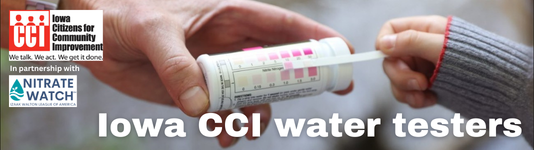
,
Thank you to everyone who joined us on our monthly water tester call yesterday!
We had some great conversations and ideas about how to get the word out there about high nitrate levels across the state. Y'all are doing the hard work - your data should be seen!
If you didn't make the Zoom, here's what you missed and a link to the recording:
- Annie shared a warning about wild parsnip. Speaking from experience here - don't touch this plant! It grows along waterways often. Here is some information about how to identify it and what to do if you do touch it. (Stay out of the sun!)
- We heard from John about testing at several sites - he's been testing for 3 years now! Thank you, John! Check out his consistent testing data here, and here, and here. Notice how the highest numbers are all from this year.
- New tester Chris shared about his testing reasons and methods. We love to see the fun rigs y'all come up with!
- Barb shared about testing strategically to see whether certain streams increase the nitrates in Ioway Creek... turns out, the numbers are just consistently high.
- Barb also mentioned her 151 ft deep well has 0 nitrates. A good reminder we need to think about water quality and quantity, and work to make sure pollutants don't reach into our groundwater supplies!
- Jenna shared that surface waters can be high, but her town's municipal water is consistent at 3 ppm. The source of municipal water matters a lot when it comes to nitrates!
- Ryan and Linda both recommended reading Iowa Environmental Council's Environmental Risk Factors and Iowa's Cancer Crisis if you want to learn more about what we're facing here. Ryan is right - this publication uses credible, peer-reviewed data to draw some direct lines between our state's environment and our personal health.
- And: one of the authors, Kerri Johanssen, top policy staff at the Iowa Environmental Council, will be hosting a workshop at our convention!
- What else did you hear at the meeting? What were the highlights for you?
One note: It's true factory farms spread manure in spring and fall, which is why we tend to see higher numbers at those times, but I wanted to flag another issue. CAFOs use lagoons - large pits - to store waste until it can be spread. With all the rain we've had, lagoon leaks are not uncommon! The Iowa DNR is responsible for oversight of these, but we know they are understaffed and lagoon overflows/spills are rarely reported. Just another reminder to stay safe and look into the land use around your sites!
There are a lot of people in Iowa who just don't know about the dangers of nitrates in drinking water and recreation water. Y'all are coming up with some great ideas on how to share and who really needs to hear this. Let's keep that momentum going! Please remember to fill out this survey so we can work together to get the word out.
Register for our July 15 Letter-to-the-Editor training! We're hosting a Zoom where both new and seasoned letter writers can join to chat about writing letters to share about nitrates in our waterways just in time for Nitrate Pollution Awareness Week July 27-31!
Finally, RSVP for our next monthly water tester call, Thursday, July 30, 5:00 pm, here!
For clean water in Iowa,
Morgan Bradley
Community Organizer
Katie Bryan
Membership Development Director
P.S. - We'd love to have a big meet up of CCI water testers at our statewide convention: Building the Iowa WE Need on July 25! It's a chance to see how your work connects with others in the organization. We have a workshop on water, we'll be talking about the elections, and we have some incredible speakers joining us. Follow this link to learn more and register!
P.P.S. - Finally, I (Morgan) was on my way back from Madison, WI during our call because toured a manure digester. It's a fascinating (and dangerous, uneconomical, unsustainable) system to capture methane from manure for energy. We also learned digesters can make nitrate water issues worse! Check out this publication from our friends at Food & Water Watch to learn more. |